


When it comes to metal cladding one has to consider two types of fasteners, primary and secondary. Primary fasteners are those that anchor the cladding to the structural support members (elements) whereas secondary fasteners are generally used to attach ancillary items such as flashings and for stitching side laps. Whilst most profilers provide tables and/or details of the primary fasteners and some stitching screws there is little information pertaining to the secondary fasteners. Traditionally cladding contractors use one or other form of blind rivet (pop rivet).
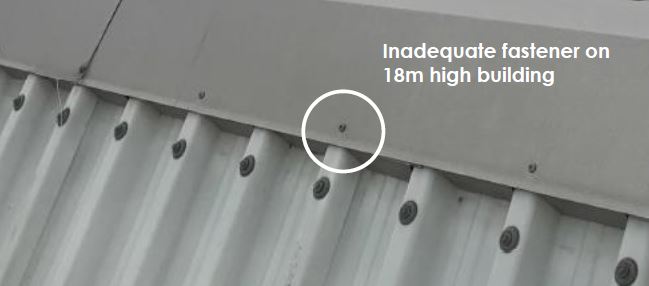 What is often overlooked is that in addition to corrosion these fasteners have to withstand a variety of loading conditions such as pull-out, pull-over, vibration and differential thermal movement. In addition they are required to clamp together materials with different degrees of fragility e.g. metal and polycarbonate cladding. The fasteners used to attach flashings to the leading edges of a building are subjected to the maximum wind loading conditions imposed on the cladding. Wind load increases exponentially with height above average ground level together with proximity to or location on topographical features such as hills or adjacent to edges of cliffs etc. The roughness of the surrounding terrain, roof profile (shape) and adjacent buildings can contribute to increased wind loading.
The performance characteristics of the secondary fasteners therefore have to be proportional to the loading conditions. As a rule of thumb the bigger or more exposed a building the more robust the secondary fasteners have to be.
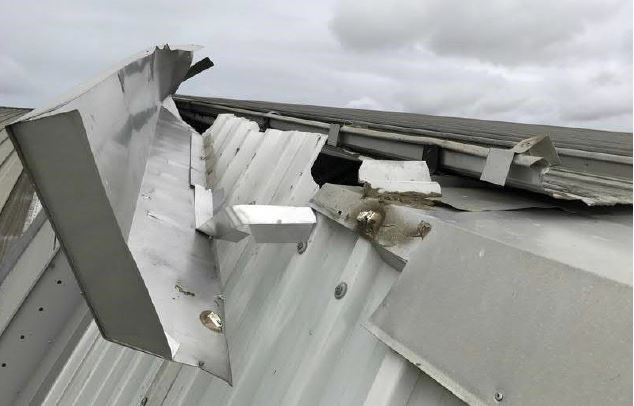 In addition to having the correct effective length, diameter or thread type it is important to take into account the following;
- Pull-out strength
- Pull-over value (can be increased by introducing a bonded washer)
- Vibration
- Shear induced by thermal movement on both the fastener and materials being joined
- Susceptibility of materials to being crushed or inhibited from free differential thermal movement e.g. interface between metal and translucent materials
Please visit our website www.samcra.co.za for other articles and papers on subjects pertaining to cladding.

